
Casing expansion creates a material reduction in the cross-sectional area of the annulus, thereby physically impairing the ability of gas or liquids to flow. For example, for 7” (177.8 mm) casing in 8.75” (222.3 mm) hole, a 1/8” (3.2 mm) expansion reduces the cross-sectional area at that point by 12.9%. A ¼” (6.4 mm) expansion reduces the cross-sectional area by 26.3%. This can materially impair or seal annular leakage and also ensure better performance of injected sealing mediums such as cement or polymers.
A downhole tool that exerts internal expansion pressure on casing can cause it to rupture if the casing is severely pitted, corroded, affected by hydrogen sulphide embrittlement, or has non-uniform support in the annulus. Properly positioned in the wellbore in an interval with uniform annular characteristics, REED will not rupture the casing. Because its hydraulic activation permits infinitely variable expansion force, REED can be operated to function effectively on all wellbore and casing conditions.
The ability of steel to bend – technically defined as ductility – is an essential element of modern industrial manufacturing. Metal forming or the shaping metal using pressure has been a key element of vehicle, ship and aircraft manufacturing for decades. Oilfield experience has demonstrated that all steel tubulars such as tubing and drill pipe and casing will stretch and bend without permanent damage. It can also be safely expanded without rupturing.
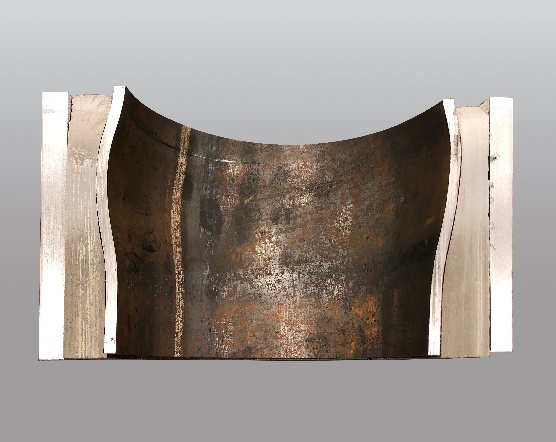
Cutaway showing cement compression caused by casing expansion.
REED is designed to work in all sizes and grades of API casing. For a specific well, Radial routinely secures samples of the casing in which REED is to be deployed. An expansion test on the casing sample is conducted in the shop, using the same tool and expansion element that will be run in the well. During the test, pressure is increased until the exact point at which ductility (expansion) begins, thereby determining the maximum possible expansion under full pressure.
The perceptions of how cement will react to pressure are usually formed by the behaviour of construction concrete on surface. Concrete, however, is a combination of cement and other materials such as sand or gravel (aggregate). This added material creates a multitude of shear points within the concrete leading to cracks and crumbling.
These conditions do not exist in oilwell cement downhole; cement used to complete oil and natural gas wells does not contain aggregate. Lab tests have proven that under compression, pure cement in a confined space will react with plasticity and constrict, not crack, thereby closing off micro-annular leak pathways and worm holes that cause gas and fluid leakage. Copies of lab tests confirming the plasticity of pure cement are available on request.
Once casing achieves full plasticly and expands to the point of full molecular realignment, it does not return to its original shape. Lab tests of expanded casing have revealed an increase in Vickers hardness without any evidence of cracking or weakening on the external face of the bulge. However, the impact on tensile strength cannot be tested on a distorted steel sample. Copies of the laboratory tests are available upon request.
The casing in older wells in which REED will be employed is rarely available for surface expansion testing. However, the original drilling records, including the mill specifications (grade; weight API specs) are essential. Casing integrity and caliper logs in API-spec casing can factor in the Barlow equation, which adjusts casing strength for measured internal pitting. As well, a hoop stress analysis can be performed to better predict casing behavior. Understanding the properties of the materials behind casing – and their uniformity – will help determine the likely and desired outcome prior to operations.
Understanding the condition of the wellbore annulus is essential to successful REED deployment. The best place to expand casing to reform cement and seal leaks is above the source of leakage in an interval with the best possible cement quality and against a formation that will provide the most resistance to enhance cement compression. This is determined by a review of open hole logs, cement bond logs, compensated neutron logs and noise/temp logs. REED is very effective when expanding casing inside another string of casing.
No. REED is not a bridge plug, but a method of changing the physical properties of the annulus to either seal or enhance other sealing methods to stop annular leakage. REED can serve as an “after market” external packer to ensure other sealing methods – such as injecting cement, resins or other sealing compounds – are more successful because REED restricts annular flow and ensures the injected materials stay where they will be the most effective. Experience with cement squeezes above casing expansions shows evidence that the success rate of this proven method of sealing can be increased.
When deployed in conjunction with a sensitive annular pressure/flow device, the results of casing expansion can be detected on surface, depending on depths of lower source formations versus upper charged intervals. This can be a key tool in determining that the interval being expanded is above the source of the flow. REED can positively isolate gas leakage intervals that are difficult to confirm from traditional noise/temp logs or gas isotope analysis.
REED is a hydraulically operated device conveyed into the hole on jointed tubing or coiled tubing (CT) and activated by pressure from surface inside the work string. Its length is about 6 meters (20 feet), meaning that is shorter than a joint of tubing and will not require excessive lubricator length for CT deployment. REED is unset and closed by using pressure in the annulus. Using fluid flow or string weight, it is easy to detect from surface when REED is fully closed and ready for another deployment.
REED is designed to be used in a one-, two- or three-element configuration. Hundreds of expansions followed by casing caliper logs have determined that the elements can perform at least four expansions before replacement. This means that in a single run, REED can put a minimum of four, eight or twelve expansions in the casing, or more depending on well conditions.
Successfully changing the characteristics of the annulus of a wellbore requires significant pre-planning and as much information as is available. REED has a strong technical team of experienced log analysis and downhole tool experts to help perform remediation operations at the lowest possible cost with the greatest likelihood of success.
Out-of-round or distorted casing is a growing problem in extended reach horizontal wells. With smaller casing diameters in the build section or horizontal intervals, this can impede the passage of completion and other tools in and out of the wellbore. Traditional mechanical methods of casing report don’t work in non-vertical wellbores. Deployed on coiled tubing, REED can travel to where it is required in the wellbore. With the power to expand casing, REED can be pre-sized to return casing to circularity at an attractive cost without impairing casing integrity using other methods such as milling. If REED can fit inside the distorted interval, the tool can be configured to allow access to the wellbore.